Peptides are everywhere in the wellness industry, but do they improve your skin?
The short answer is "yes," peptides do work but there is a caveat: the only way you can be sure a peptide will improve your skin to use one that is clinically proven with scientific data backing the claims.
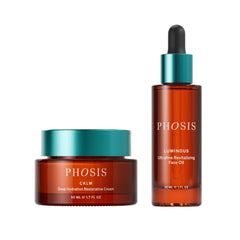
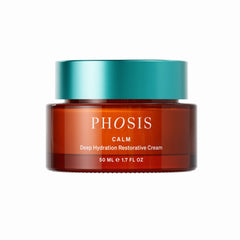
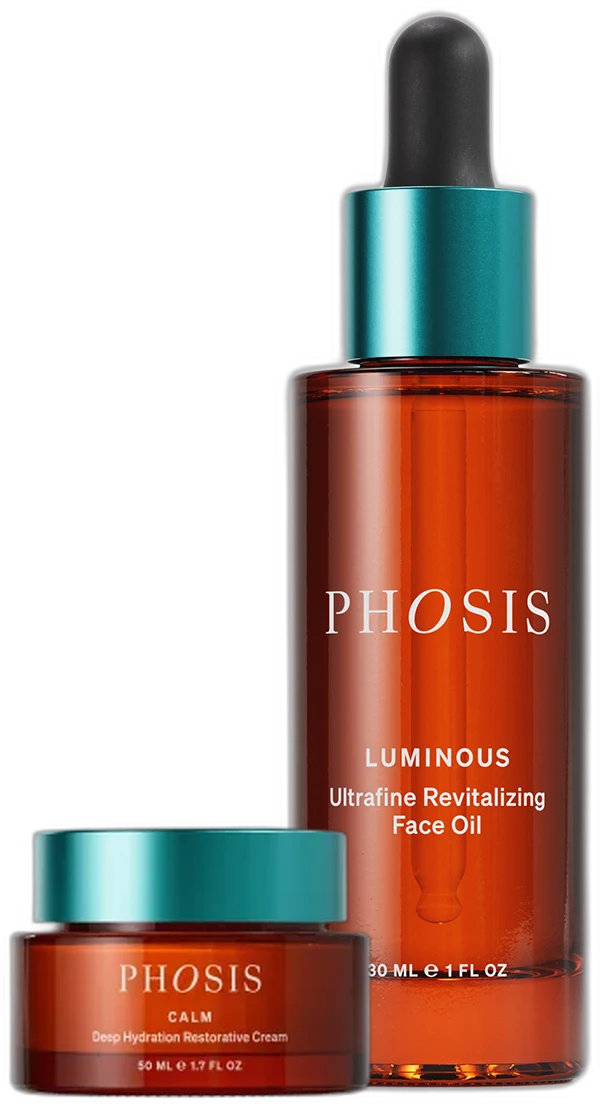
When choosing ingredients for Calm Deep Hydration Restorative Cream, I researched extensively to find peptides that are clean, but more importantly, clinically proven. Trendy ingredients may get a lot of attention on social media, but without data supporting their claims, they are just another opportunity to waste your time and money.
My research led me to Acetyl Hexapeptide-8; one of the most clinically studied peptides available today. Also known as Argireline®, it is one of the key ingredients in Calm Deep Hydration Restorative Cream. Renowned for being a neurotransmitting-inhibiting peptide, Acetyl Hexapeptide-8 works in an unexpected way: it reduces muscle contractions in your face with continued use.
What a Peptide Actually Is
A peptide is a short chain of amino acids. Amino acids are the units your body uses to build proteins, and the two proteins that decide how firm and smooth your skin looks are collagen and elastin. A protein is a long chain of those units. A peptide is a short one, sometimes only three or four amino acids long.
That difference in length is the whole point.
Collagen itself is too large to travel through the outer layer of skin. A collagen cream sits on the surface, where it holds water and makes skin feel softer, but it does not become collagen in your dermis. A peptide is small enough to have a genuine chance of getting somewhere, and short enough that your skin cells read it as a message rather than as raw material.
The message is the mechanism. When collagen in the dermis breaks down, it leaves behind specific fragments. Skin reads those fragments as evidence that something needs repairing and responds by producing more. Signal peptides are built to copy those fragments. Applying one is a way of asking your skin to start rebuilding without having to damage it first to get the request through.
How Peptides Work on Skin
Not all peptides do the same job. Research groups them into four categories based on how they act, and the scientific literature on cosmetic peptides uses the same four divisions.
|
Type of peptide |
What it does |
Best known example |
|---|---|---|
|
Signal peptides |
Prompt fibroblasts to produce more collagen, elastin and other structural proteins |
Palmitoyl Pentapeptide-4 (Matrixyl®) |
|
Carrier peptides |
Deliver trace minerals such as copper to the enzymes involved in repair |
Copper Tripeptide-1 (GHK-Cu) |
|
Neurotransmitter-inhibiting peptides |
Reduce the nerve signal that tells facial muscles to contract |
Acetyl Hexapeptide-8 (Argireline®) |
|
Enzyme-inhibiting peptides |
Slow the enzymes that break collagen and elastin down |
Soy and rice derived peptides |
Most peptide products contain something from the first or third group. Signal peptides work on production. Neurotransmitter-inhibiting peptides work on movement. They are solving different problems, which is why they are often formulated together rather than chosen between.
There is one obstacle every peptide has to clear, and it is worth understanding before you spend money on one. Peptides are water-loving molecules, and the outer layer of your skin is built to keep water-loving molecules out. Poor permeability through the stratum corneum is the single biggest limitation on how well a cosmetic peptide performs. Formulators get around it by attaching a fatty acid to the peptide, which is why so many INCI names begin with "palmitoyl," or by using encapsulation and delivery systems that carry the peptide past the barrier.
This is the reason two creams can list the identical peptide on the label and behave nothing alike.
Meet Acetyl Hexapeptide-8: The Peptide Built for Your Skin
First introduced in 2001, Acetyl Hexapeptide-8 is a peptide that has been at the forefront of modern skincare lines. It's often called a "botox-like" peptide or "no-tox" and for good reason.
Acetyl Hexapeptide-8 is proposed to work by inhibiting the SNARE complex responsible for synaptic vesicle fusion, thereby reducing facial muscle contractions, which is the same underlying mechanism targeted by neurotoxin injections, but delivered topically, and without downtime.
As a neurotransmitter-inhibiting peptide, it works by blocking signals that cause muscles to contract as we talk, laugh, and smile — the very movements that form deep expression lines over time. For women in midlife who are already experiencing accelerated collagen loss, this added line of defense against dynamic wrinkles is particularly meaningful.
What the Research Shows
The science behind Acetyl Hexapeptide-8 is growing, and it's compelling.
Preclinical and clinical studies indicate that Acetyl Hexapeptide-8 may reduce wrinkle depth, improve skin elasticity, and enhance hydration. In a study published in the International Journal of Cosmetic Science, Acetyl Hexapeptide-8 produced significant wrinkle reduction after 4 weeks of treatment, supported by histological evidence. After 12 weeks of use, clinical scoring showed improvements in smoothness, radiance, skin pore appearance, elasticity, and firmness.
Acetyl Hexapeptide-8 also enhances skin hydration by promoting water retention in the epidermis, leading to improved skin texture and elasticity. Given that menopausal skin frequently struggles with moisture retention, this dual action, softening expression lines and restoring hydration, makes it especially well-suited for this life stage.
Safety-wise, the Cosmetic Ingredient Review (CIR) panel has assessed Acetyl Hexapeptide-8 as safe for cosmetic use, with studies indicating no significant adverse effects reported in clinical trials. Additionally, the Environmental Working Group, also known as the EWG rates the ingredient as "1-2" which is the lowest possible risk rating.
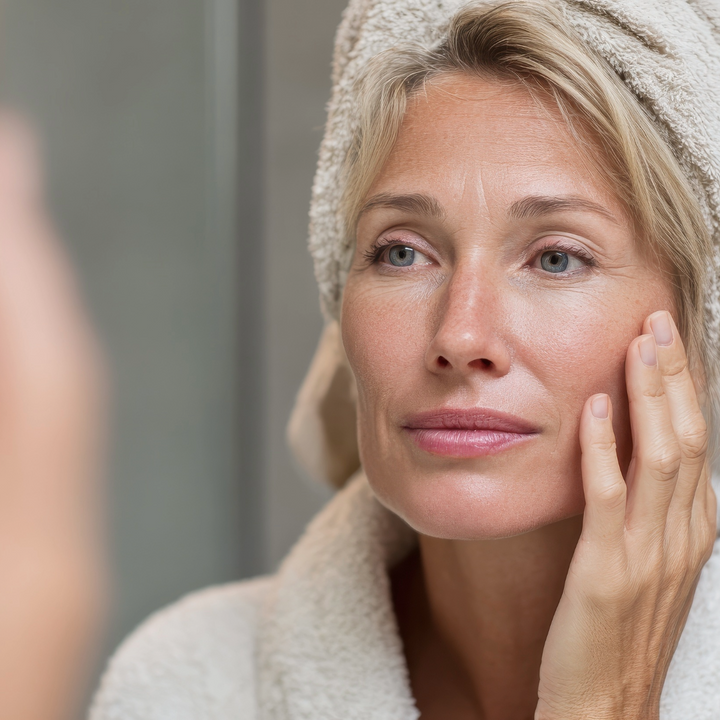
Why Peptides Matter More in Perimenopause and Menopause
Estrogen does far more for your skin than most women are ever told. Fibroblasts, the cells that build collagen, carry estrogen receptors. When estrogen falls, those cells slow down while the enzymes that clear away old collagen carry on at the same pace.
The result is well documented. Research indicates a decline of up to 30% in types I and III collagen within the first five years after menopause, with a slower annual loss continuing after that. This is not the gentle decline of ordinary aging. It is steeper, it is concentrated into a few years, and it is why your skin can look different at 52 than it did at 48.
Alongside it, the barrier thins and stops holding water the way it used to, which is a separate problem with its own set of fixes.
Peptides suit this stage of life for a practical reason. Many of the ingredients with the strongest anti-wrinkle data, prescription retinoids and acids in particular, work partly by irritating skin into renewing itself. Menopausal skin often cannot take that anymore. Peptides ask skin to do more without stripping it, which means you can use them daily on skin that has become reactive.
They are not a replacement for what your body stopped producing. They are a way of supporting what is still working.
What Peptides Cannot Do
I would rather you buy the right thing for the right reason, so here is the honest side of the ledger.
Peptides are not injectables. Acetyl Hexapeptide-8 softens muscle contraction. It does not stop it. If you have deep, set static lines, a topical peptide will soften how they look, not erase them.
The effect is not permanent. Every peptide result depends on continued use. Stop for two months and your skin returns to its own baseline. That is true of every effective active, not a flaw specific to peptides.
Peptides do not protect you from what is causing the damage. UV exposure degrades collagen faster than any topical ingredient rebuilds it. A peptide cream without daily sun protection is a bucket with a hole in it.
The evidence is not equal across all four categories. Signal peptides and neurotransmitter-inhibiting peptides carry the most human clinical data. Enzyme-inhibiting peptides are far more thinly studied. Marketing rarely makes that distinction, so you have to.
The word "peptide" on a label tells you almost nothing. It does not tell you which peptide, at what concentration, in what delivery system, or whether the finished formula was ever tested. Those four unknowns are the difference between a product that works and a product that photographs well.
Why Formulation Matters
For perimenopausal and menopausal women, how an ingredient is chosen for the formula matters just as much as what it does. Many skincare products rely on unproven ingredients or don't include ingredients at the recommended dose equivalent to what was tested in a clinical trial. That means that even if an ingredient is included in a formulation, there might not be enough of it to actually do much for the skin.
I chose to build Phosis differently by working closely with my cosmetic chemists to ensure the products included the right ingredients at the correct percentages for maximum efficacy. The result? Skincare that actually improves your skin. With continued use, Acetyl Hexapeptide-8 is proven to soften muscle contractions, thereby reducing the risk for deep wrinkles. Is it the same as Botox? No, but for those looking to avoid needles or extend the life of their Botox injections, Acetyl Hexapeptide-8 is the perfect ingredient.
How to Use Peptides in Your Routine
Peptides are among the easiest actives to fit into a routine, because they do not fight with anything.
Where they go. Apply from thinnest to thickest. Cleanse, apply any water-based serum, then your peptide cream, then a facial oil last to seal everything in. If you want the full sequence, I set it out in my eight-step routine for perimenopause and menopause.
Morning, night, or both. Both. Peptides are not photosensitising, so there is no reason to keep them to the evening. Twice-daily use is how they were tested and how they perform best.
How long before you judge them. Give it eight weeks minimum. In the clinical data on Acetyl Hexapeptide-8, measurable wrinkle change appeared at four weeks and the broader improvements in smoothness, elasticity and firmness at twelve. Most women quit at three weeks, which is the point at which nothing has happened yet.
What they layer with. Hyaluronic acid, glycerin, niacinamide, ceramides and antioxidants are all comfortable company. If you use a retinoid, apply your peptide cream afterwards or on alternate nights; there is no chemical conflict, but stacking two actives on thinning skin is how barriers break. Copper peptides are the one exception worth separating, so keep those away from direct acids and vitamin C in the same layer.
If your skin is reactive. Patch test on the inner arm or behind the ear for three days before applying anything new to your whole face. And if your barrier is already compromised, repair that first. Actives applied to a damaged barrier sting, absorb unevenly, and get blamed for problems they did not cause. I wrote a full guide to repairing a damaged skin barrier if that sounds like where you are.
Sunscreen. Every morning, without exception, or the rest of this is theatre.
Peptides Compared With the Other Actives
Women in midlife are usually choosing between four or five ingredients, so here is how peptides sit against the rest.
|
Ingredient |
What it does best |
Irritation risk |
Suits menopausal skin? |
|---|---|---|---|
|
Peptides |
Support collagen production and soften expression lines |
Very low |
Yes, daily, including on reactive skin |
|
Retinoids |
The strongest evidence base for wrinkle reduction |
High, especially on thinning skin |
Sometimes, at low strength and reduced frequency |
|
Vitamin C |
Antioxidant protection and brightness |
Low to moderate depending on form |
Yes, usually in the morning |
|
Niacinamide |
Barrier support, redness, pore appearance |
Very low |
Yes |
|
Ceramides |
Rebuild the lipid barrier estrogen loss depletes |
None |
Essential at this stage |
Peptides and retinoids are not rivals. Retinoids have the deeper clinical record; peptides are the option you can actually keep using when your skin stops tolerating that record. Plenty of women in midlife end up with a low-strength retinoid twice a week and a peptide cream every day, which is a sensible place to land.
If you are weighing topical hormones as another route, I have written separately about estrogen face creams and whether they are safe.
How to Read a Peptide Label
Six things I check on any product before I believe the claim on the front.
-
Find the INCI name, not the trade name. Argireline® is Acetyl Hexapeptide-8. Matrixyl® is Palmitoyl Pentapeptide-4. The trademark is marketing; the INCI is the ingredient.
-
Look at where it sits in the list. Peptides are active at low percentages, so they will never be near the top. But if the peptide appears after the preservatives at the very bottom, you are looking at a label claim rather than a dose.
-
Prefer a named, tested complex. A trademarked peptide ingredient usually means a supplier who has run studies on it and will show you the data. Our seven actives are combined in Resilara-7™ for exactly that reason.
-
Check the packaging. Peptides degrade with heat, light and air. Opaque, airless packaging is a sign the formulator cared what happened to the ingredient after it left the lab.
-
Count them. A product listing eight peptides is more likely to contain traces of eight than a meaningful dose of any. One or two, properly dosed, does more.
-
Ask whether the finished product was tested. Ingredient studies are not product studies. A brand that has tested the actual formula on real skin will publish the results, because it cost them money to get them.
Knowing what to avoid helps too. I keep a running list of the seven worst ingredients for perimenopausal and menopausal skin.
The Bottom Line
Menopausal skin changes are real, and they're driven by biology, genetics, lifestyle, and environment. Peptides are one of the most exciting ingredients for menopausal skin, and Acetyl Hexapeptide-8 is backed by science and clinical data. As a skincare ingredient, it's ideal for addressing the expression lines and skin quality changes that come with hormonal shifts. And when it's formulated inside a clinically-tested cream like Phosis Calm, it works with your skin, not against it.
You deserve science-backed skincare built for this moment, not false promises in a jar.
Questions women like you asked
What are peptides in skincare?
Peptides are short chains of amino acids, the same units your body uses to build collagen and elastin. In skincare they act as messengers rather than building blocks, prompting skin cells to produce more structural protein or, in the case of neurotransmitter-inhibiting peptides, to relax the muscle contractions that form expression lines.
Do peptides actually work on skin?
Yes, with conditions attached. The peptide has to be one with published human data, it has to be included at the concentration that was tested, and the formula has to deliver it past the outer layer of skin. Signal peptides and neurotransmitter-inhibiting peptides have the strongest clinical support. A product that meets none of those conditions can list a peptide and do nothing.
How long do peptides take to work?
Plan on eight to twelve weeks. In the clinical research on Acetyl Hexapeptide-8, wrinkle depth changed measurably at four weeks and improvements in smoothness, elasticity and firmness were recorded at twelve. Hydration improves much faster, often in the first week, but that is the moisturiser doing its job rather than the peptide.
What is the difference between peptides and collagen?
Collagen is a large protein your skin makes for itself. A peptide is a short fragment. Collagen applied topically is too big to penetrate, so a collagen cream hydrates the surface without adding collagen to your dermis. A peptide is small enough to signal the cells that build collagen, which is a different and more useful thing to do.
Are peptides better than retinol?
They are not better, they are gentler. Retinoids have the larger clinical record for wrinkles, but they are also the ingredient menopausal skin most often stops tolerating. Peptides work more slowly and cause far less irritation, so they can be used every day, indefinitely, on skin that has become reactive. Many women use both.
Can I use peptides with retinol, vitamin C and niacinamide?
Yes. Peptides have no chemical conflict with retinoids, vitamin C, niacinamide, hyaluronic acid or ceramides. The practical caution is not the pairing but the total load: if your skin is thinning and reactive, running a retinoid and an acid and a vitamin C all at once will damage the barrier regardless of the peptide. Copper peptides are the one type worth keeping in a separate step from acids and vitamin C.
Do peptides work like Botox?
No. Acetyl Hexapeptide-8 targets the same signalling pathway that neurotoxin injections interrupt, but it does so topically and to a far smaller degree. It softens the appearance of expression lines with continued use. It does not immobilise muscle, and it will not deliver an injectable's result.
Are peptides safe for sensitive or menopausal skin?
Peptides are among the lowest-irritation actives available, which is why they suit hormonally reactive skin. The Cosmetic Ingredient Review panel has assessed Acetyl Hexapeptide-8 as safe for cosmetic use. Irritation from a peptide product usually comes from something else in the formula, most often fragrance or essential oils, rather than from the peptide itself.
Are oral collagen peptides the same as the peptides in my face cream?
No. Oral collagen peptides are hydrolysed collagen taken as a supplement and digested. Topical cosmetic peptides are specific short sequences designed to signal skin cells at the point of application. They are studied separately and one is not a substitute for the other.
Should I use peptides in the morning or at night?
Both. Peptides are not photosensitising and do not break down in daylight the way some actives do, so twice-daily application is fine and matches how they are tested in trials. Consistency matters much more than timing.
What percentage of peptide should a product contain?
There is no single number, because every peptide has its own tested use level and suppliers publish different ranges. The more useful question is whether the brand used the concentration the clinical study used. Brands that did will tell you when asked. Brands that did not will talk about the ingredient instead of the dose.
Do peptides help with sagging and loss of firmness?
They help with firmness more than with sagging. Peptides that support collagen and elastin production can improve how firm and elastic skin measures and looks over a few months. Structural sagging, where the underlying fat pads and bone have shifted, is not something any topical ingredient corrects.
Can peptides help the skin on my neck and chest?
Yes, and that skin usually needs it most. The neck and décolletage are thinner, have fewer oil glands, and lose firmness earlier than the face. Extend whatever you apply to your face downwards, always sweeping upwards, and use sun protection there as well.
Will it sting if my skin reacts to everything?
It's formulated for reactive, compromised skin: no fragrance, no retinol, no acids. In HRIPT testing it was 100% non-irritating.
How quickly will I see a difference?
The first week is mostly relief as the stinging and tight dryness ease. The visible change builds over weeks two to eight.